
 07970 824104
Recently I travelled to the Isle of Man and to Tenerife with a family member who used a folding mobility scooter for outdoor mobility.
We had selected a small folding model from Careco – the Pride Go Go Carbon; weighing 17kg (without the battery); 19kg with. It folds up to the size of a small suitcase so is easily transportable. We were a little concerned as to how easy it would be to fly with the scooter and had worries such as:
- would the scooter arrive at our destination

- would it be damaged

 - would the airline refuse to take it.
However all these worries were completely unnecessary as both airlines we flew with (Easyjet to the Isle of Man; and British Airways to Tenerife) excelled themselves and we had no issues at all.
Prior to flying we requested special assistance at the airport – there are different levels of assistance you can request and we opted for the one which allowed my family member to use the scooter through the airport from check-in desk, through security, around the departure lounge and shops, right up to the gate. When requesting special assistance in advance they required details of the scooter- such as dimensions, type of battery, whether it was a removable battery or not, and wattage of the battery.
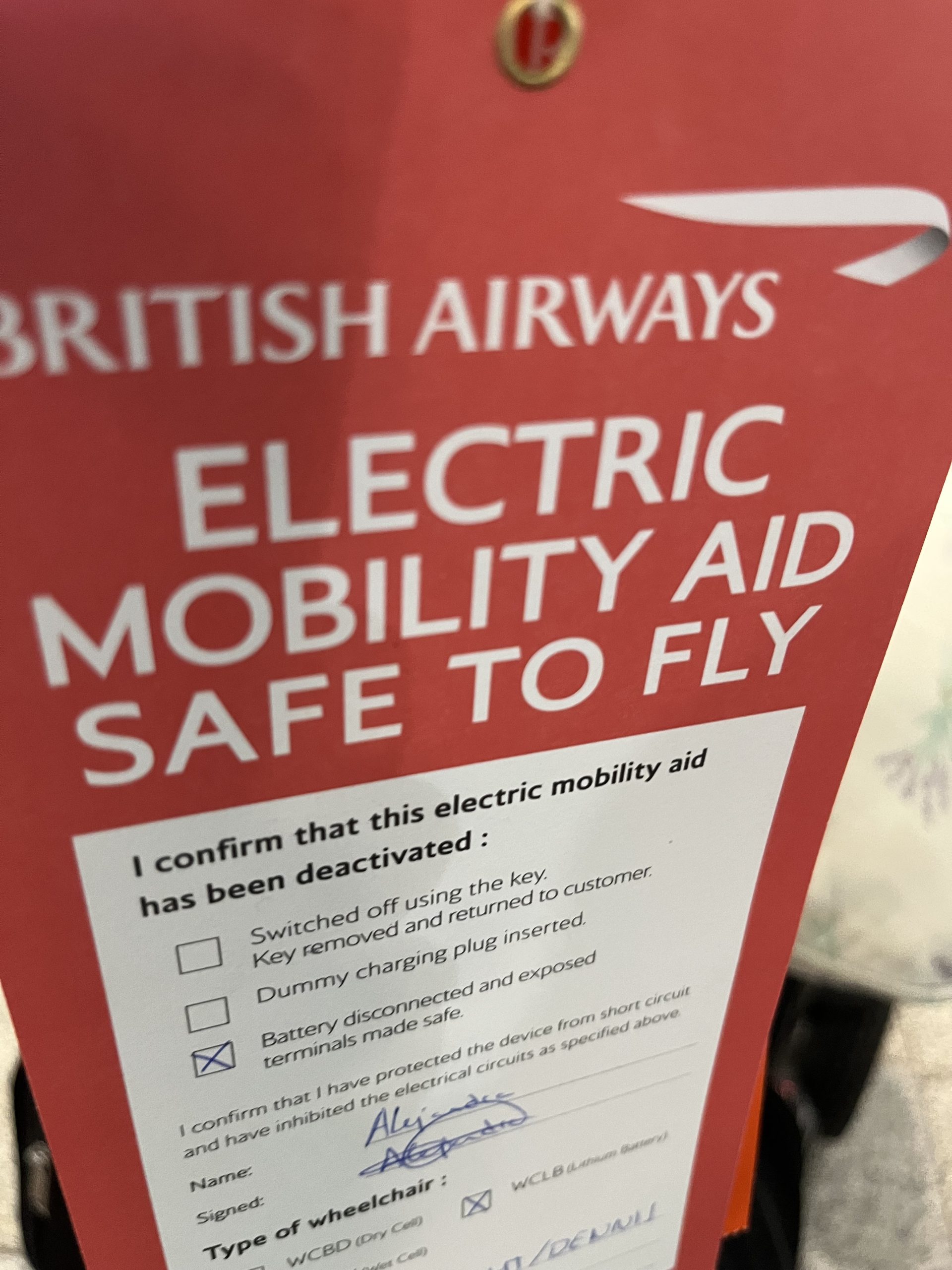
At check-in all the details were already loaded into the airline computer system, and these were just confirmed by check in staff and a labels attached to the scooter – see photo’s below. These confirmed that the scooter was safe to fly (we were advised that we would need to remove the battery and take it into the aircraft cabin with us); and a note to ground crew to return the scooter to the aircraft door on landing so it can be used through security etc on arrival at our destination.
We were boarded first which allowed us more time to get to seats, and fold the scooter and advise ground crew of the method of folding etc. On landing at our destination we were disembarked last; however we noted that we did not have to wait any extra time for baggage as baggage hadn’t arrived by the time we got there!
At the Isle of Man, my family member used the aircraft steps to walk down and the scooter was positioned at the bottom of the steps ready for him to use. We were then escorted to the baggage reclaim area.
At Tenerife, there were a lot of other wheelchair users on the flight, and therefore they used an Ambulift – which was like a large portacabin which raised up to the level of the aircraft, and then lowered to ground level, and then drove us to security. See photographs of the Ambulift (attached to a different aircraft & driving around the airport in Tenerife). There was a huge bonus on arrival at Tenerife as this airport is renown for long queues at security – however all wheelchair users were taken to the front of the security queue which saved us lots of time. Once through the airport we were also shown a different place to pick up a taxi – separate from the long queue and were picked up almost instantly. So it was definitely a good move to travel with the scooter rather than hire one at our destination. Coming home from Tenerife they were just as efficient, and used a similar process to the one at Gatwick airport; giving us priority security queue which again saved a very long queue
.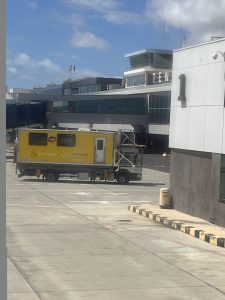 Ambulift driving around the airport
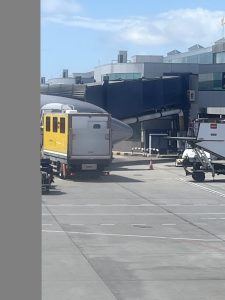 Amublift attached to plane
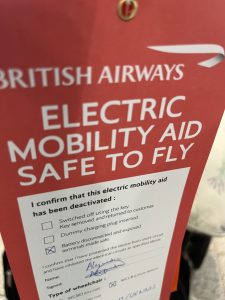
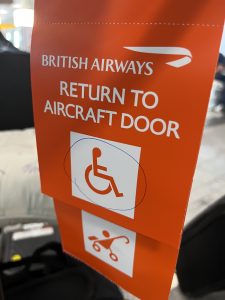 Labels attached to scooter
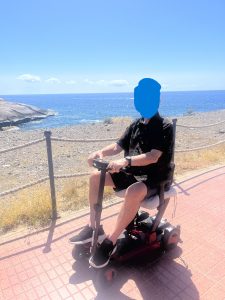 Enjoying the sunshine in Tenerife
Overall we were certainly impressed with the service from both airlines and all airports involved and would not hesitate to encourage people who need this type of equipment to continue travelling – just plan it in advance and advise the airline within 48 hours of travel and things should go smoothly for you.
